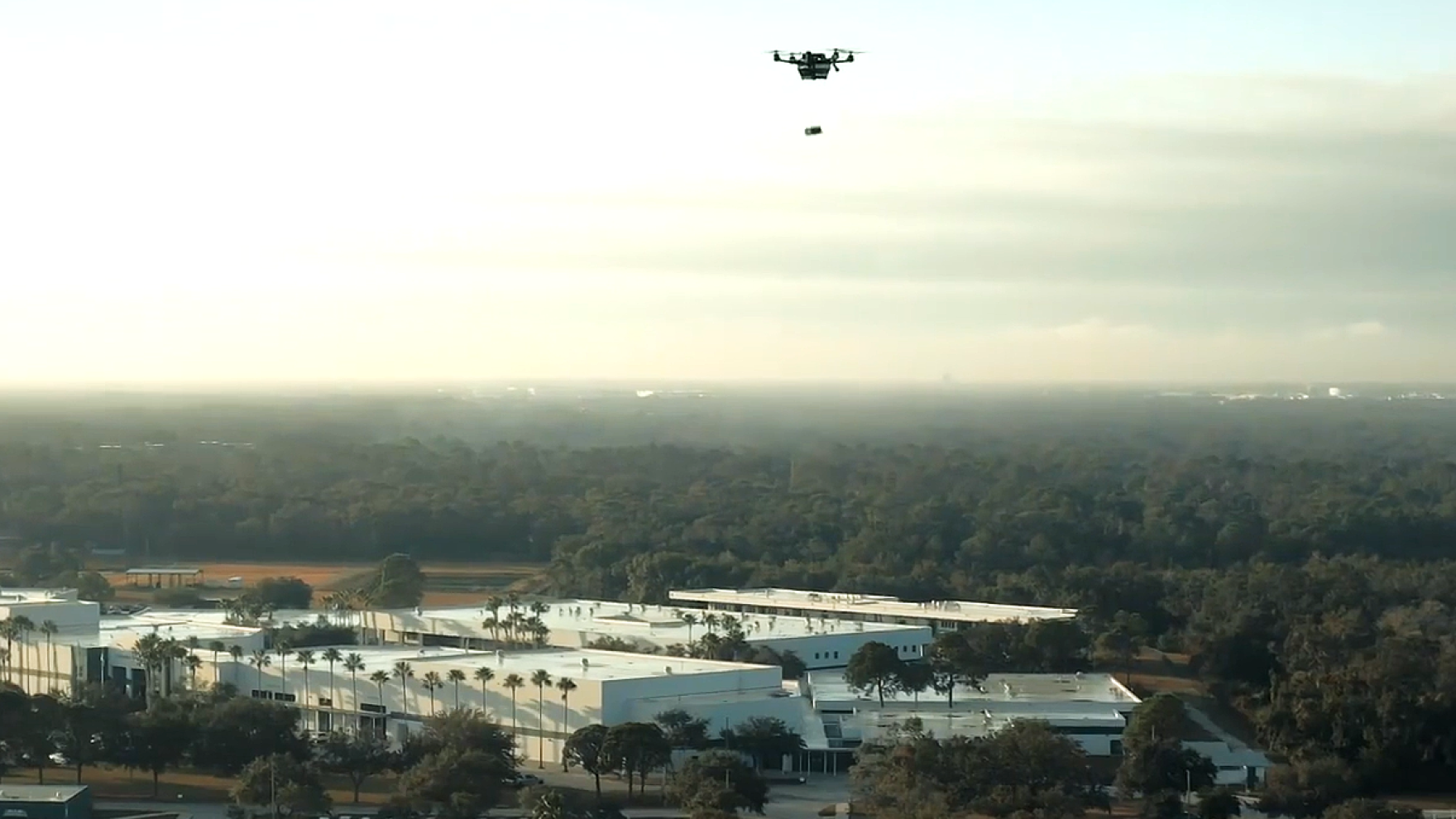
Paramedics responding to severe trauma near South Shore could get whole blood delivered by drone in under three minutes if the Hillsborough County Commission approves a new pilot program at its Wednesday, Sept. 2 meeting.
Tampa General Hospital announced the program Aug. 3, calling it the nation's first EMS-driven drone delivery system for pre-hospital whole blood. Drones would launch from two Hillsborough County Fire Rescue stations: Station 9 near Faulkenburg Road and Sabal Park, and Station 37 in Riverview. Together, the two sites would cover a 70-square-mile area that officials say has the county's highest volume of penetrating trauma and hemorrhagic injuries.
Station 37 in Riverview sits directly adjacent to the unincorporated South Shore communities of Apollo Beach and Ruskin, which are served by HCFR. Whether the 70-square-mile coverage zone extends into those neighborhoods has not been specified in public documents.
The program pairs Tampa General with Hillsborough County Fire Rescue, the University of South Florida Health Morsani College of Medicine, OneBlood, the Florida Center for Emergency Medical Services and Archer First Response Systems, which provides the drone hardware. HCFR personnel would operate the aircraft.
When a 911 call involves life-threatening blood loss, dispatchers would send first responders to the scene. Those responders can simultaneously request a drone carrying whole blood. Because whole blood contains red blood cells, plasma and platelets in a single unit, paramedics can begin replacing what a patient is losing before the ambulance reaches the hospital.
"Our crews are often first at the scene of an accident," rescue division chief Todd Carnell of Hillsborough County Fire Rescue said in the TGH announcement. "This program puts an essential, lifesaving resource directly in our hands at the scene, giving our first responders more tools to improve the chances of survival of a patient in crisis."
Dr. Jason Wilson, TGH's chief of emergency medicine and founding chairman of the USF Health Morsani College of Medicine Department of Emergency Medicine, said faster access to whole blood is "a major predictor of a patient's likelihood of survival."
WUSF first reported the program details Aug. 4. TGH officials say they plan to expand the coverage area over time, using data from the pilot to guide growth.
This outlet contacted Hillsborough County Fire Rescue for independent comment but did not receive a response. No county commissioner has commented publicly on the Sept. 2 vote.
As we reported July 28, Manatee County recently deployed a rescue drone for beach emergencies, prompting questions about whether similar technology could serve Apollo Beach. This TGH-HCFR program is a distinct effort focused on blood delivery to trauma scenes rather than water rescue.
If commissioners approve the proposal Sept. 2, the drone system is expected to come online in October 2026. The BOCC meeting is open to the public; residents can attend to comment before the vote.






.jpg)